Blog / SEO
How to Get More Google Reviews Without Breaking Google's Rules
By Danny Blea, Founder, The Search Source · 9 min read
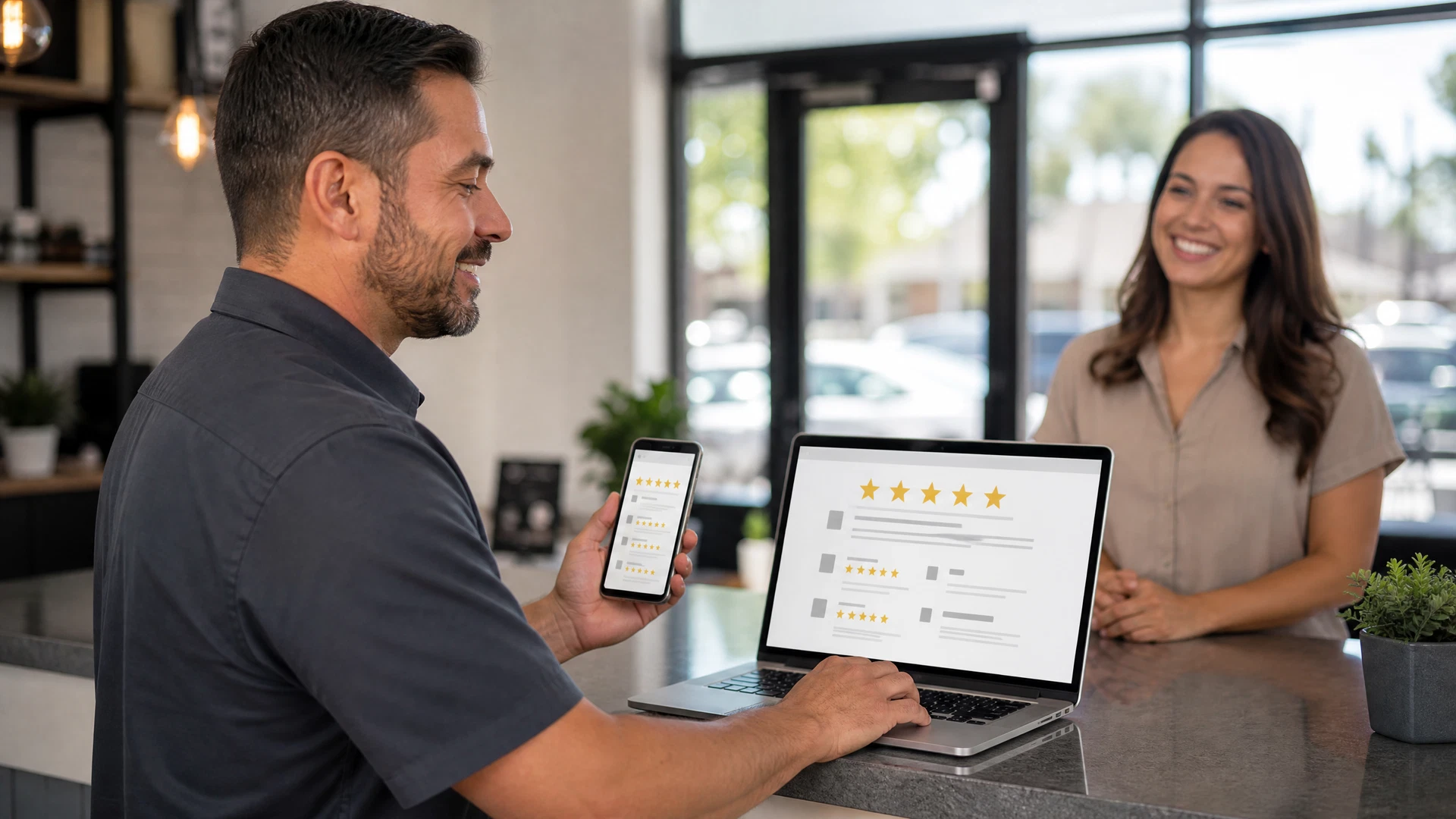
To get more Google reviews without breaking Google's rules, we recommend implementing a systematic, post-service request workflow focused on perfect timing, friction-free SMS or email links, and personalized outreach. In competitive markets, customer reviews act as both a primary trust signal for prospective buyers and a critical ranking factor for local search visibility. However, many business owners inadvertently jeopardize their entire online presence by chasing shortcuts, offering financial incentives, or utilizing prohibited software tools that violate Google's Terms of Service.
When Google detects suspicious review patterns—such as a sudden influx of five-star ratings from accounts with no history, or systematic filtering of negative feedback—it can suspend your Business Profile entirely. Restoring a suspended profile costs time, revenue, and peace of mind. Therefore, building a sustainable reputation management strategy requires absolute adherence to platform guidelines combined with consistent operational discipline. In this guide, we break down our proven framework for generating authentic reviews safely, avoiding common policy traps, and turning customer satisfaction into long-term local authority.
Understanding Google’s Review Policies: What NOT to Do
Before implementing any new outreach initiative, every business owner and marketing manager must understand what is strictly forbidden by Google. Google's content policies exist to ensure that reviews remain honest, unbiased, and genuinely reflective of consumer experiences. Violating these guidelines can result in review deletion, ranking penalties, or complete profile suspension.
The Dangers of Review Gating
Review gating is the practice of filtering customers before asking them to leave a public review. Typically, a business sends an internal survey asking clients if they had a positive or negative experience. If the customer indicates satisfaction, they are directed to Google. If they indicate dissatisfaction, they are routed to a private feedback form.
Google explicitly prohibits review gating because it skews public perception by selectively suppressing negative feedback. While businesses naturally want to protect their ratings, hiding unhappy customer experiences violates the core spirit of open consumer platforms. If Google identifies a gated feedback loop on your website or through your software provider, your earned reviews risk being purged.
Why Incentives and Giveaways Backfire
Offering discounts, freebies, gift cards, or entry into a raffle in exchange for a Google review is another common violation. While it may seem like a harmless way to encourage participation, incentivized reviews introduce bias. When a customer stands to gain a financial benefit from leaving feedback, they are far more likely to leave a positive rating than they would organically, distorting the integrity of the review ecosystem.
Google's automated filters and manual review teams actively scan for language mentioning discounts, free services, or contest entries. Furthermore, competitors can easily flag incentivized review campaigns, leading to rapid removal of reviews and potential penalties for your profile. Authentic appreciation should always be its own reward, reinforced by exceptional service rather than transactional bribes.
Bulk Solicitation and Review Stations
Setting up an in-store tablet where customers are prompted to leave reviews before leaving the premises often triggers spam filters. When multiple reviews originate from the same IP address within a short time window, Google's algorithms often flag them as inauthentic or coerced. Similarly, purchasing bulk review packages from third-party vendors is a fast track to permanent listing suspension. Authentic reviews must come from distinct user accounts acting independently across natural geographic and temporal distributions.
Building a Compliant Review Request Workflow
Achieving steady review growth does not require risky shortcuts; it requires a repeatable, professional workflow integrated naturally into your daily operations. When you make the process frictionless and respectful of your customers' time, response rates increase dramatically without crossing ethical or algorithmic lines.
Timing Is Everything
The single most important factor in securing a positive review is timing. If you wait two weeks after completing a project or service to ask for feedback, the emotional resonance of the positive experience has faded, and the customer has moved on to other priorities.
For service-based businesses and contractors, the ideal time to request a review is immediately following project completion or at the exact moment of verbal customer delight. When the client expresses satisfaction with the final result, your team should capitalize on that momentum. For e-commerce or transactional businesses, automated follow-up sequences should trigger shortly after product delivery or service fulfillment, ensuring the interaction remains fresh in the consumer's memory.
Choosing the Right Communication Channel
Deciding whether to request reviews via email or SMS depends heavily on your customer demographic and industry norms. SMS messages enjoy exceptionally high open and response rates, especially for mobile-first consumers and home service appointments. An SMS text containing a direct, short link to your review profile removes friction, allowing the client to complete the action in seconds while waiting in their car or sitting on their couch.
Email remains highly effective, particularly for B2B engagements, professional services, or complex projects where clients appreciate a detailed thank-you note. Regardless of the channel, the communication should always come from a recognizable human sender rather than a sterile corporate alias. Personalization builds connection, and connection inspires action.
Crafting the Request Message
Your review request should be brief, polite, and direct. Avoid long paragraphs, aggressive pressure, or demanding language. A successful request acknowledges the specific work performed, expresses genuine appreciation for their business, and provides a clear, single click path to your review link.
For example, a compliant text message might read: "Hi Sarah, it was a pleasure upgrading your electrical panel today. If you have 60 seconds, we would truly appreciate your feedback on Google: [Link]. Thank you for choosing our team!" This approach is respectful, transparent, and completely aligned with platform guidelines.
The Power of Strategic Local SEO Alignment
Generating a steady stream of reviews does not happen in a vacuum. It is an integral component of a comprehensive local visibility strategy. When combined with rigorous on-page optimization, localized landing pages, and technical authority, authentic reviews propel your business to the top of regional search results.
In highly competitive metropolitan markets, businesses must optimize every facet of their digital footprint to stand out. For organizations operating in Nevada, tailoring your digital strategy through specialized resources like our guide on SEO Las Vegas ensures your foundational targeting matches regional search intent. Reviews reinforce these foundational efforts by validating your authority to both prospective clients and search engine crawlers.
Furthermore, review acquisition plays a direct role in map positioning. To dominate localized search results, businesses must align their review velocity with advanced optimization techniques outlined in our analysis on how to rank in the Las Vegas map pack. Ranking at the top of the map pack requires not only proximity and keyword relevance, but also a consistent accumulation of high-quality, keyword-rich customer feedback over time.
For specialized trade professionals, building authority requires niche-specific alignment. Contractors and home service providers can explore our detailed playbook on Google Business Profile optimization for Las Vegas contractors to align their review generation efforts with category-specific best practices, service-area configurations, and citation consistency.
Automating Outreach Without Losing the Human Touch
As businesses scale, manually tracking every client interaction and sending individual review requests becomes operationally unsustainable. Modern organizations increasingly turn to intelligent automation to streamline customer follow-ups without sacrificing personalization.
Integrating CRM platforms with automated triggers allows your business to dispatch review requests the moment an invoice is marked paid or a service ticket is closed. However, automation must be managed carefully to avoid sounding robotic or spammy. Utilizing modern tools such as AI agents for local businesses allows companies to intelligently segment customer interactions, personalize timing based on client behavior, and manage multi-channel follow-up sequences safely within compliance boundaries.
Automation should handle the administrative burden of scheduling and delivery, but the underlying tone must remain empathetic and customer-centric. By striking the right balance between technology and human warmth, you can scale your review acquisition engine while protecting your brand reputation.
Mastering Review Response Habits
Collecting reviews is only half the battle; how you respond to them significantly influences public perception and search engine trust signals. Every review—whether glowing praise or constructive criticism—represents an opportunity to demonstrate your company's professionalism and commitment to client satisfaction.
Responding to Positive Reviews
When a customer takes the time to leave a five-star review, responding promptly is essential. Your response should express sincere gratitude, reference the specific service or project completed, and subtly reinforce your local relevance. For example, thanking a client for trusting your team with their home renovation in Summerlin adds natural context without sounding forced.
Avoid copy-pasting identical boilerplate responses to every review. Personalized replies signal to future readers that real human beings stand behind your brand, fostering deeper trust and encouraging other satisfied clients to share their experiences.
Handling Negative or Constructive Feedback
Negative reviews are inevitable in business, but how you handle them matters more than the review itself. A calm, professional, and empathetic response to a negative review often converts a disgruntled critic into a loyal advocate, and more importantly, reassures prospective clients who read the exchange.
Never argue, become defensive, or invalidate the customer's experience publicly. Instead, acknowledge their frustration, apologize for falling short of expectations, and invite them to continue the conversation offline via phone or direct email to resolve the issue. Once the matter is resolved amicably, satisfied customers will frequently update their review voluntarily.
Frequently Asked Questions
Can I ask my customers to mention specific keywords in their Google reviews?
No, you should never ask customers to include specific keywords, service names, or geographic terms in their reviews. Google's guidelines require reviews to be completely organic and natural. Suggesting specific wording looks manipulative to automated filters and can result in the review being flagged or removed.
What should I do if I receive a fake or spam review on my Google Business Profile?
If you receive a review that violates Google's content policies—such as spam, hate speech, or feedback from an individual who was never a client—you should flag the review directly through your Google Business Profile dashboard and submit a formal removal request. Provide supporting documentation if necessary, though patience is required as the review process can take time.
How many reviews do I need to outrank my local competitors?
There is no fixed numerical threshold for outranking competitors. Local search ranking depends on a combination of review quantity, review quality, average star rating, review velocity, and overall profile optimization. Consistent, steady acquisition over months carries far more weight than short-term bursts of activity.
Is it permissible to reply to old reviews that we previously ignored?
Yes, you can and should respond to older reviews if you missed them previously. While recent reviews carry more weight in consumer decision-making, responding to historical feedback demonstrates ongoing customer engagement and active management of your digital presence.
Conclusion
Building a robust review profile is one of the most impactful investments you can make in your local brand authority, provided it is executed with absolute adherence to platform rules. By eliminating risky shortcuts like review gating and financial incentives, focusing on flawless timing, and integrating your outreach into a broader digital strategy, you create a sustainable engine for long-term growth.
Ready to elevate your local visibility and build a compliant, high-performing reputation management strategy? We invite you to explore our services or get in touch with our team today. Let us help you unlock your brand's full potential—get started now.